Fragment of an Unmarked Architectural Detail from the Medieval Solkhat Lapidary Collection
DOI:
https://doi.org/10.24852/2587-6112.2026.5.87.94Keywords:
archaeology, Crimea, Solkhat, lapidary holdings, stone sculpture, Seljuk style, architectural detail, Inzhi-Bey Khatun Madrasah, fountain, poolAbstract
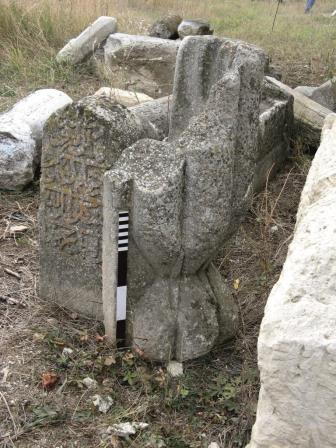
The object under discussion represents a unique example of medieval stone sculpture. It was found within the urban area of Stary Krym (former Solkhat, Crimea, Eski-Krym) during collecting “various architectural fragments” conducted in 1925 and 1926. The exact location of its discovery is unknown. The limestone piece is usually identified as part of a column or sherefe (balcony) of a minaret. A large fragment currently adorns a rose flowerbed near the Ozbek Han Mosque. The find clearly belonged to a prefabricated structure. This is confirmed by special flutes for the brackets, as well as fragments of the iron clamps themselves, preserved in situ, and the lead fill that held them in place. The entire structure could easily have been assembled from eight pieces, identical in size and presumably in shape. Other compositional variations are certainly possible, but this is the most optimal. The reconstructed structure was a rather elegant stone enclosure with a circular internal plan. Its external configuration took the form of a weakly expressed star-shaped polyhedron, the protruding corners of which were shaped into half-rosettes with rounded petals. The function of the object is largely determined by the size and shape of the find. These suggest it belonged to the basin of fountain or pool, typically used in landscaping gardens, courtyards and individual rooms. Absolute parallels have not yet been identified between either the object itself or the reconstructed structure, but certain similarities, primarily decorative and architectural parallels, are demonstrated in detail by certain structures in Asia Minor and neighbouring lands from the Seljuk period.
References
Bashkirov, A. S. 1926. In Krym (Crimea) 2, 108–125 (in Russian).
Bashkirov, A. S. 1927. In Krym (Crimea) 3 (1), 122–144 (in Russian).
Bocharov, S. G. 2021. In Povolzhskaya arkheologiya (Volga River Region Archaeology) 36 (2), 121–135 (in Russian).
Bocharov, S. G., Sitdikov, A. G. 2016. In Bocharov, S. G., Sitdikov, A. G. (eds.). Miras – Nasledie. Tatarstan – Krym. Gorod Bolgar i izuchenie tatarskoy kul'tury v Tatarstane i Krymu v 1923–1929 gg.: v 3 t. (MIRAS – HERITAGE. Tatarstan – Crimea. Bolgar City and the Study of the Tatar Culture in Tatarstan and the Crimea in 1923–1929: in 3 volumes) 1. Kazan: “Aster Plyus” Publ., 22–53 (in Russian).
Kirilko, V. P. 2011. In Stratum plus (6), 125–210 (in Russian).
Kirilko, V. P. 2019. In Mamichev, E. E. (ed.). Azak i mir vokrug nego (Azak and the World Around It). Series: Donskie drevnosti (Antiquities of the Don) 12. Azov: Azov Historical-Archaeological and Palaeontological Museum-Reserve Publ., 93–97 (in Russian).
Kramarovskii, M. G., Tepliakova, A. N. 2016. In Seidaliev, E. I. (ed.). Krym v zolotoordynskii period. Krymskii Iurt Zolotoi Ordy: nasledie ischeznuvshei imperii: katalog vystavki (Crimea in the Golden Horde Period. Crimean Yurt of the Golden Horde: Legacy of a Vanished Empire: Exhibition Catalog). Simferopol: “Tarpan” Publ., 107–214 (in Russian).
Lomakin, D. A. 2015. Musulmanskie pamiatniki Starogo Kryma XIII–XV vv.: istoriia izucheniia, sovremennoe sostoianie (Muslim Monuments of Stary Krym of the 13th –15th cc.: the History of Studying and the Contemporary State). Simferopol: “Solo-Rich” Publ. (in Russian).
Bocharov, S. G., Sitdikov, A. G. (eds.). 2017. Miras – Nasledie. Tatarstan – Krym. Gorod Bolgar i izuchenie tatarskoy kul'tury v Tatarstane i Krymu v 1923–1929 gg.: v 3 t. (MIRAS – HERITAGE. Tatarstan – Crimea. Bolgar City and the Study of the Tatar Culture in Tatarstan and the Crimea in 1923–1929: in 3 volumes) 2. Kazan: “Izdat-Print” Publ. (in Russian).
Bocharov, S. G., Sitdikov, A. G. (eds.). 2017. Miras – Nasledie. Tatarstan – Krym. Gorod Bolgar i izuchenie tatarskoy kul'tury v Tatarstane i Krymu v 1923–1929 gg.: v 3 t. (MIRAS – HERITAGE. Tatarstan – Crimea. Bolgar City and the Study of the Tatar Culture in Tatarstan and the Crimea in 1923–1929: in 3 volumes) 3. Kazan: “Aster Plyus” Publ. (in Russian).
Sharifulin, R. F. 2013. In Baranov, V. S., Valeev R. M., Salikhov R. R., Poluboiarinova M. D., Sharifullin R. F. (eds.). Velikii Bolgar (Great Bolgar). Moscow; Kazan: “Feoriia” Publ., 242–251 (in Russian).
Campbell, J. W. P., Boyington, A. 2018. In Studies in the History of Gardens & Designed Landscapes. Vol. 38:3, 247–267, DOI: 10.1080/14601176.2018.1452827
Günkut, A. 1995. In Muqarnas. An annual Islamic art and architecture, XII, 63–83.
Downloads
Published
How to Cite
Issue
Section
License
Copyright (c) 2026 V.P. Kirilko

This work is licensed under a Creative Commons Attribution-NonCommercial 4.0 International License.