Local and Imported Plants of the Selitrennoye Settlement (based on materials from the excavation area LI (51))
DOI:
https://doi.org/10.24852/2587-6112.2026.5.253.269Keywords:
archaeology, Golden Horde, Selitrennoye settlement, archaeobotany, macroremains, millet, bread wheat, chickpeaAbstract
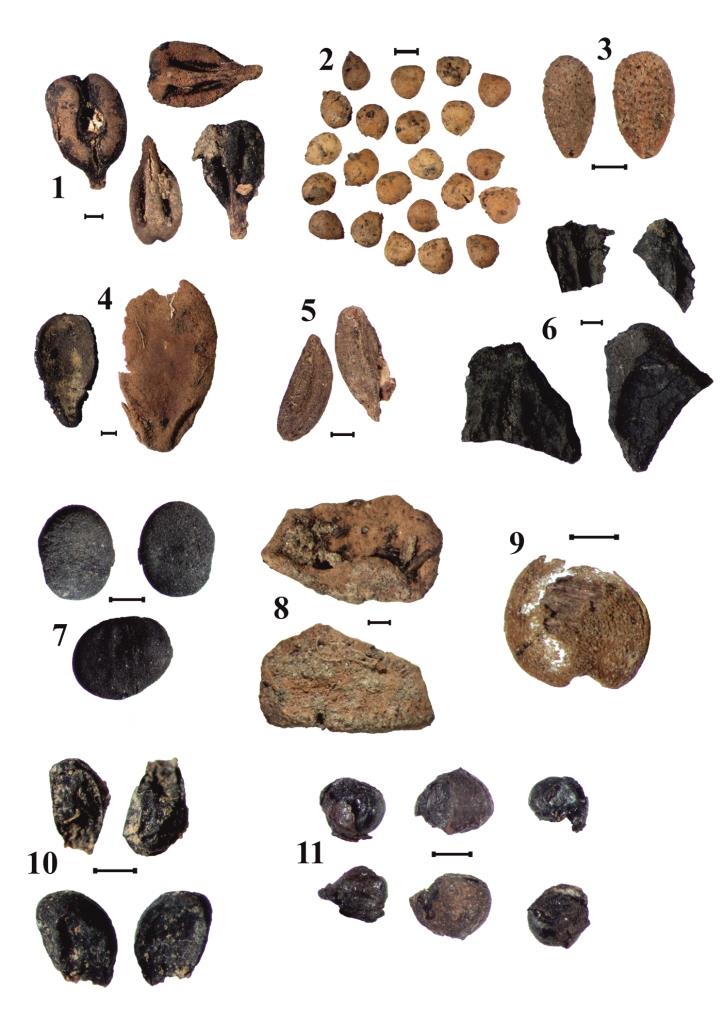
During excavations at the Selitrennoye settlement (Astrakhan region), aiming search for plant macroremains (seeds, grains, fruits of cultivated and wild plants), a series of 23 soil samples was collected to recover plant macro-remains (seeds, grains, and fruits of cultivated and wild plants). The samples were subsequently subjected to flotation and the retrieved remains were dried and analyzed under laboratory conditions. Sampling was carried out primarily from the rooms of a 14th-century homestead complex and its associated subterranean features cut into the sterile soil (subsoil); one sample was taken at a significant distance from the homestead. A total of at least 15 species of cultivated and utilized plants, as well as 61 taxa of wild and weed plants, were identified. The cultural layer of the site exhibits specific preservation conditions, allowing plant remains to survive not only in a carbonized state but also in mineralized and even desiccated/dehydrated forms. The main grain crops found are common millet and bread wheat. Among garden food plants, grape, water-melons and fig stand out; stone fruit pits were also encountered, along with rare finds such as sumac and eggplant.The definitions of some species – walnuts or celery family species – remain questionable due to insufficient preservation. The finds of grain are distributed relatively evenly among the samples, while the remains of garden plants and water-melons are confined to several contexts. An attempt was made to isolate imported species, and evidence of local millet cultivation was obtained.
References
Babenko, A. N., Sergeev, A. Yu. 2019. In Povolzhskaya arkheologiya (Volga River Region Archaeology) 30 (4), 161–170 (in Russian).
Zilivinskaya, E. D. 2020. Otchet ob arkheologicheskikh raskopkakh na territorii ob"ekta kul'turnogo naslediya federal'nogo znacheniya «Gorodishche Saray-Batu, stolitsa Zolotoy Ordy v XIII-XV vv.» v zone stroitel'stva mezhposelkovykh gazoprovodov ot GRS Vol'noe na s. Vol'noe, s. Selitrennoe, pos. Seroglazovo v Kharabalinskom rayone Astrakhanskoy oblasti v 2019-2020 gg. (Report on excavations within the territory of the cultural heritage site of federal significance "City of Sarai-Batu, the capital of the Golden Horde in the 13th–15th centuries", in the construction zone of inter-settlement gas pipelines from the Volnoye gas distribution station to the villages of Volnoye and Selitrennoye, and the settlement of Seroglazovo in the Kharabali district of the Astrakhan Oblast in 2019–2020) Vol. II. Moscow. Archive of the Institute of Archaeology of the Russian Academy of Sciences. Dossier 76543 (in Russian).
Kats, N. Ya., Kats, S. V., Kipiani, M. G. 1965. Atlas i opredelitel' plodov i semyan, vstrechayushchikhsya v chetvertichnykh otlozheniyakh SSSR (Atlas and identification guide for fruits and seeds found in the quaternary deposits of the USSR). Moscow: “Nauka” Publ. (in Russian).
Laktionov, A. P. 2009. Flora Astrakhanskoy oblasti (Flora of Astrakhan region). Astrakhan: Astrakhan State University (in Russian).
Lebedeva, E. Yu. 2016. In Chernykh, E. N., Mishina, T. N. (eds.). Mezhdistsiplinarnaia integratsiia v arkheologii (po materialam lektsii dlia aspirantov i molodykh sotrudnikov) Interdisciplinary Integration in Archaeology (based on Lectures for Postgraduate Students and Young Employees). Moscow: Institute of Archaeology, Russian Academy of Sciences, 118–146 (in Russian).
Lebedeva, E. Yu. 2022. Koval, V. Yu. (ed.). Tsentral'nyy bazar Bolgara i ego okruzhenie (mezhdistsiplinarnye issledovaniya po materialam raskopok 2011–2019 gg.) (The central bazaar of Bolgar and its surroundings (interdisciplinary research based on materials from 2011–2019 excavations)). Series: Materialy i issledovaniya po arkheologii Bolgarskogo istoriko-arkhitekturnogo kompleksa (Materials and research on the archaeology of the Bolgar historical and architectural complex) IV. Moscow; Saint Petersburg: “Nestor-Istoriya” Publ., 183–207 (in Russian).
Lebedeva, E. Yu., Kubankin, D. A. 2014. In Kratkie soobshcheniia Instituta arkheologii (Brief Communications of the Institute of Archaeology) 236, 339–344 (In Russian).
Lebedeva, E. Yu., Yavorskaya, L. V., Antipina, E. E. 2016. In Matveeva, N. P. (ed.). Ekologiya drevnikh i traditsionnykh obshhestv (Ecology of Ancient and Traditional Societies) 5, part 2. Tyumen: Tyumen State University, 98–101 (in Russian).
Pigarev, E. M. 2016. In Povolzhskaya arkheologiya (Volga River Region Archaeology) 16 (2), 164–181 (in Russian)
Sergeev, A. Yu. 2018. In Arkheologiia Evraziiskikh stepei (Archaeology of Eurasian Steppes) 4, 299–303 (In Russian).
Sergeev, A. Yu. 2023. Rastitel`nye ostatki v syrtsovykh kirpichakh iz Khakassii I Nizhnego Povolzh`ia. (Plant remains in mud bricks from Khakassia and the Lower Volga region). Konferentsiya «Vostochnye drevnosti v istorii Rossii. Epokha srednevekov`ia i eio arkheologicheskoe okruzhenie» Institut Arkheologii RAN, Moskva, 17.03.2023 (Conference "Oriental Antiquities in the history of Russia. The Middle Ages and its archaeological surroundings" Institute of Archeology of the Russian Academy of Sciences, Moscow, 17.03.2023) (in Russian).
Sergeev, A. Yu., Babenko, A. N., Kuprianov, D. A., Korobov, D. S. 2022. In Rossiiskaya arkheologiya (Russian Archaeology) (4), 63–76 (In Russian).
Sergeev, A. Yu., Lebedeva, E.Yu. 2021. In Chernykh, E. N., Zav’yalov, V. I. (eds.). Analiticheskie issledovaniia laboratorii estestvennonauchnykh metodov (Analytical studies of the laboratory of the natural science methods) 5. Moscow: Institute of Archaeology, Russian Academy of Sciences, 285–307 (in Russian).
Fеdorov-Davydov, G. A. 2001. Zolotoordynskie goroda Povolzh’ia: keramika, torgovlia, byt (Golden Horde Cities in the Volga Area: Pottery, Trade, Everyday Life). Moscow: Moscow State University (in Russian).
Shefer, E. 1981. Zolotye persiki Samarkanda. Kniga o chuzhezemnykh dikovinakh v imperii Tan (The Golden Peaches of Samarkand). Moscow: “Nauka” Publ. (in Russian).
Bojňanský, V., Fargašová, A. 2007. Atlas of Seeds and Fruits of Central and East-European Flora. The Carpathian Mountains Region. Dodrecht: Springer.
Marshall, L. J., Almond, M. J., Cook, S. R., Pantos, M, Tobin, M. J., Thomas, L. A. 2008. In Spectrochimica Acta. Part A: Molecular and Biomolecular Spectroscopy. Vol. 71. Issue 3, 854–861.
McCobb, L. M. E. 2001 Fossilisation process in terrestrial environments and their impact on archaeological deposits. Thesis (Ph.D.). University of Bristol.
Mir‑Makhamad, B., Stark, S., Mirzaakhmedov, S., Rahmonov, H., Spengler, R. N. III. 2023. In Archaeological and Anthropological Sciences. Vol. 15:124, 1–18.
Murphy, C. 2014. In Smith, C. (ed.). Encyclopedia of Global Archaeology. New York: Springer, 4948–4952.
Murphy, P., Wiltshire, P. L. 1994 (for 1993). In Circaea vol. 11 (1), 1–6.
Sabato, D., Peña-Chocarro, L. 2021. Maris Nostri Novus Atlas Project. Seeds and fruits from the Mediterranean Basin. Espana: Doce Calles ediciones.
van der Veen, M., Morales, J. 2017. In Dionysius A. Agius, Emad Khalil, Eleanor Scerri, Alun Williams (eds.) Human interaction with the Environment in the Red Sea. Leiden, Boston: Brill, 254–289.
Published
How to Cite
Issue
Section
License
Copyright (c) 2026 A.Yu. Sergeev

This work is licensed under a Creative Commons Attribution-NonCommercial 4.0 International License.