
TRACEOLOGY ON METAL. EXPERIMENTS AND INTERPRETATION OF THE ARCHAEOLOGICAL ITEMS
Keywords:
archaeology, traceology, functionality, use wears, experimentation, metal tools, Palmela pointsAbstract
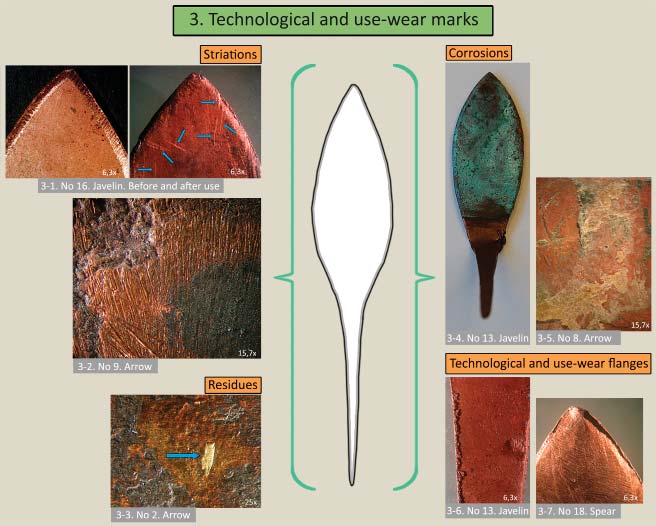
Traceology on metal has been one of the last specialities to join the world of functional studies of prehistoric materials. That is why its experimental base is still scarce and should be developed in the future. Its methodology corresponds to that of the Traceology on fl int or other rocks and materials such as bone, antler, shell and several others, with special interest in systematic and replicative experimental designs, taking into account all the independent variables that intervene in the experimentation and a careful characterization of the traces obtained. In the case of metal, the raw material and post-casting processes are important because they will determine that the tool is softer and ductile or more hard and brittle. Thus, a metal weapon or tool will develop traces of use that will be different qualitatively and quantitatively also in function of these technical elements. A second aspect that determines the study of traces on metal objects is the presence of various types of corrosion with different intensity that may cover some traces and limit the interpretation, as we will see in the experimental examples that we present. Traceology on metal has a very recent development, there are still few works carried out, but future experiments and new techniques of treatment, observation, and analysis of archaeological pieces will be able to increase our knowledge on it.
References
Anderson, K. 2011. Slashing and thrusting with Late Bronze Age spears: analysis and experiment. Antiquity, (85), 599–612.
Brandherm, D. 2011. Use-Wear on Bronze Age Halberds: the case of Iberia. In Mödlinger, M., Uckelmann, M. & Matthews, S. (Eds.), Bronze Age Warfare: Manufacture and Use of Weaponry. BAR International Series 2255. Oxford: Archaeopress. pp. 23–38.
Brandherm, D., Aranda Jiménez, G., Sánchez Romero, M. & Montón Subías, S. 2011. Las armas en El Argar: aspectos sociales, rituales y funcionales. In Memorial Luis Siret. I Congreso de Prehistoria de Andalucía: la tutela del patrimonio prehistórico, Consejería de Cultura, Junta de Andalucía., Antequera, 607–610.
Can Aksoy, Ö. 2018. Functions and uses of metallic axe-heads and arrowheads from Safah, Oman: An analysis of metalwork wear and weapon design. Journal of Archaeological Science: Reports. (19), 727–752.
Delibes de Castro, G. & Santiago Pardo, J. 1997. Las fortifi caciones de la Edad del Cobre en la Pení nsula Ibé rica. In Garcí a Castro, J.A.; Antona del Val, V. & Azcue Brea, L. (Coords.) La guerra en la Antigü edad. Una aproximació n al origen de los ejé rcitos en Hispania. Ministerio de Defensa. Madrid, 85–108.
Dolfi ni, A. 2011. The function of Chalcolithic metalwork in Italy: an assessment based on use-wear analysis. Journal of Archaeological Science (38), 1037–1049.
Doonan, R. C. P.; Day, P. M. & Dimopoulou-Rethemiotaki, N. 2007. Lame excuses for emerging complexity in Early Bronze Age Crete: the metallurgical fi nds from Poros Katsambas and their context. In Day, P. M. & Doonan, R. C. P. (Eds.) Metallurgy in the Early Bronze Age Aegean. Oxbow Books, Sheffi eld Studies in Aegean Archaeology. Sheffi eld, 98–122.
Dungworth, D. 2013. An experimental study of early bronze smithing techniques. In Dungworth, D. & Doonan, R. C. P. (Eds.). Accidental and Experimental Archaeometallurgy. London, 149–152.
Fraile Vicente, A. 2008. Moldes de fundición de las edades del bronce y del hierro en la submeseta norte española. BSAA arqueología, (79) 49–73.
García Vuelta, O., Cuesta Gómez, F., Galán Domingo, E. & Montero Ruiz, I. 2014. Los moldes de fundición de bronce para hachas de talón de la Macolla (Linares de Riofrío, Salamanca). Nuevos datos sobre viejos hallazgos. Zephyrus, 74: 117–141.
González, J.E. & Ibáñez, J.J. 1994. Metodología del análisis funcional de instrumentos en sílex. Universidad de Deusto. Bilbao.
Gutiérrez Sáez, C. 1996. Traceología. Pautas de análisis experimental. Ed. Foro. Madrid.
Gutiérrez Sáez, C., López del Estal, A., Simón Martín, A., Muñoz Moro, P., Bashore Acero, Ch., Chamón Fernández, J., Martín Lerma, I., Sanz Salas, E., Pardo Naranjo, A.I. & Marín de Espinosa, J.A. 2010. Puntas de Palmela: procesos tecnológicos y experimentación. Trabajos de Prehistoria 67 (2), 405–428.
Gutiérrez Sáez, C. & Martín Lerma, I. 2015. Traceology on Metal. Use-Wear Marks on Copper-Based Tools and Weapons. In Marreiros, J.M., Gibaja Bao, J.F. & Ferreira Bicho, N. (Eds.). Use-Wear and Residue Analysis in Archaeology. Series: Manuals in Archaeological Method, Theory and Technique, 171–188. Springer International Publishing Switzerland, DOI 10.1007/ 978-3-319-08257-8_9
Gutiérrez Sáez, C., Martín Lerma, I., López del Estal, A. & Bashore Acero, C. 2014. The functionality of Palmela Points as throwing weapons and projectiles: use-wear marks. In Marreiros, J.M., Bicho, N. & Gibaja Bao, J.F. (Eds.). International Conference on Use-Wear Analysis, Use-Wear 2012. Cambridge Scholars Publishing, 442–456.
Gutiérrez Sáez, C. & Soriano Llopis, I. 2008. La funcionalidad sobre material metálico. Bases y aplicaciones de Actas del VII Congreso Ibérico de Arqueometría. Madrid 432–447.
Horn, C. 2017. Combat and ritual — Wear analysis on metal halberds from the Danish Isles and the Cimbrian Peninsula. Journal of Archaeological Science: Reports, (14), 515–529.
Kamphaus, B., 2007. Use-wear and Functional Analysis of Bronze Weapons and Armor. Journal of World Anthropology. III (1), 113–138.
Keeley, L.H., 1980. Experimental Determination of Stone Tools Uses: A Microwear Analysis. University of Chicago Press. Chicago.
Kienlin, L. & Ottaway, B. S. 1998. Flanged axes of the north alpine region: an assessment of the possibilities of use wear analysis on metal artifacts. In: Mordant, C.; Pernot, M. & Rychner, V. (Eds.). L’Atelier fu bronzier en Europe du XXº au VIII siècle avant notre ère. Actes du colloque international Bronze’96, Neuchâtl et Dijon. Tome II: Du minerai au métal, du métal à l’objet. Paris, CTHS, 271–286. (Hachas).
Kristiansen, K., 2002. The tale of the sword – swords and swordfi ghters in Bronze Age Europe. Oxford Journal of Archaeology, 21. 4., 319–332.
Lull, V., Micó, R., Rihuete Herrada, C., Risch, R. & Escanilla, N. 2017. Halberdiers and Combat Systems in the Argaric. Oxford Journal of Archaeology, 36 (4), 375–394. doi:10.1111/ojoa.12120
Molloy, B. 2011. Use-wear analysis and use-patterns of Bronze Age swords. In Uckelmann, M. & Mödlinger, M. (Eds.), Bronze Age Warfare: Manufacture and Use of Weaponry. BAR International series 2255. Oxford: Archaeopress. 67–84.
Montero Ruiz, I. 2010. Tecnología de la metalurgia de base cobre. Montero Ruiz, I. (Coor.), Manual de Arqueometalurgia. Museo Arqueológico Regional. Comunidad de Madrid, 159–188.
Muñoz Moro, P., Gutiérrez Sáez, C., López Rodríguez, M.C., Martín Lerma, I., Gibaja Bao, J.F. Herrero Corral, A.M., Flores Fernández, R. & Garrido Pena, R. 2018. Functional study of the metal grave goods from the Bell Beaker tombs of the Humanejos site (Parla, Madrid). Poster presented at AWRANA International Conference, Niza 29th mai- 1st june 2018.
Ó Ríordáin, S.P. 1937. The halberd in Bronze Age Europe: a study in prehistoric origins, evolution, distribution, and chronology. Archaeologia (86), 195–321.
O’Flaherty, R., Gilchrist, M.D. & Cowie, T. 2011. Ceremonial or deadly serious? New insight into the function of irish early bronze age halberds. In Uckelmann, M. & Modlinger, M. (Eds.). Bronze Age Warfare: Manufacture and Use of Weaponry. BAR International Series 2255. Oxford: Archaeopress, 39–52.
Ottaway, B. S. & Seibel, S. 1998. ʽDust in the windʼ: experimental casting of bronzes in sand moulds. In: Frére- Sautot, M-Ch. (Ed.) Paléometallurgie des cuivres. Actes du colloque de Bourg-en-Bresse et Beaune 17–18. octobre 1997. Monographies Instrumentum 5, Éd. Monique Mergoil. Montagnac, 59–63.
Quilliec, B. T. 2007a. Technologie des épées à l’Âge du Bronze fi nal en Europe atlantique : reconstitution de chaînes opératoires. In Évin, J. (Ed.). CONGRÈS DU CENTENAIRE: Un siècle de construction du discours scientifi que en Préhistoire XXVIe congrès préhistorique de France – Avignon, 21–25.09.2004. Vol. 3. 401–411.
Quilliec, B. T. 2007b. Vida y muerte de una espada atlántica del Bronce Final en Europa: Reconstrucción de los procesos de fabricación, uso y destrucción. Complutum (18), 93–107.
Quilliec, B. T. 2008. Use, wear and damage: treatment of bronze swords before deposition. In Hamon C. & Quilliec B. (Eds.). Hoards from the Neolithic to the Metal Ages. Technical and codifi ed practices. Session of the XIth Annual Meeting of the European Association of Archaeologists. BAR International Series 1758. Oxford: Archaeopress. 67–78.
Rovira Lloréns, S. 2007. La producción de bronces en la Prehistoria. Avances en Arqueometría 2005. Actas del VI Congreso Ibérico de Arqueometría (Girona 2005). Girona, 21–35.
Rovira Lloréns, S. & Gómez Ramos, P. 2003. Las primeras etapas metalúrgicas en la Península Ibérica. III Estudios metalográfi cos. Instituto Universitario Ortega y Gasset. Madrid.
Rovira, M. C., Palomo, A & Rodríguez, A. 2007. Metalurgia prehistórica en la Catalunya prelitoral: los instrumentos de broncista de Can Roqueta II (Sabadell, Barcelona). In Mata Perelló, J. M. (Ed.). I Congreso Internacional de minería y metalurgia en el contexto de la Historia de la Humanidad: pasado, presente y futuro. Mequinenza 6–9. Julio 2006., 505–510.
Rovira, S., Montero, I. & Consuegra, S. 1997. Las primeras etapas metalúrgicas en la Península Ibérica. I Análisis de materiales. Instituto Universitario Ortega y Gasset. Madrid
Semenov, S.A. 1964. Prehistoric technology. An experimental study of the oldest tools and artifacts from traces of manufacture and wear. Cory, Adams and Mackay Ltd. London.
Soriano Llopis, I. & Gutiérrez Sáez, C. 2007. Use - wear analysis on metal: the infl uence of raw material and metallurgical production processes. Archaeometallurgy in Europe 2007. Selected Papers. Ed. Associazione Italiana di Metallurgia. Milano. 115–124.
Downloads
Published
How to Cite
Issue
Section
License
Copyright (c) 2020 Carmen Gutiérrez Sáez, Pedro Muñoz Moro

This work is licensed under a Creative Commons Attribution-NonCommercial 4.0 International License.
















